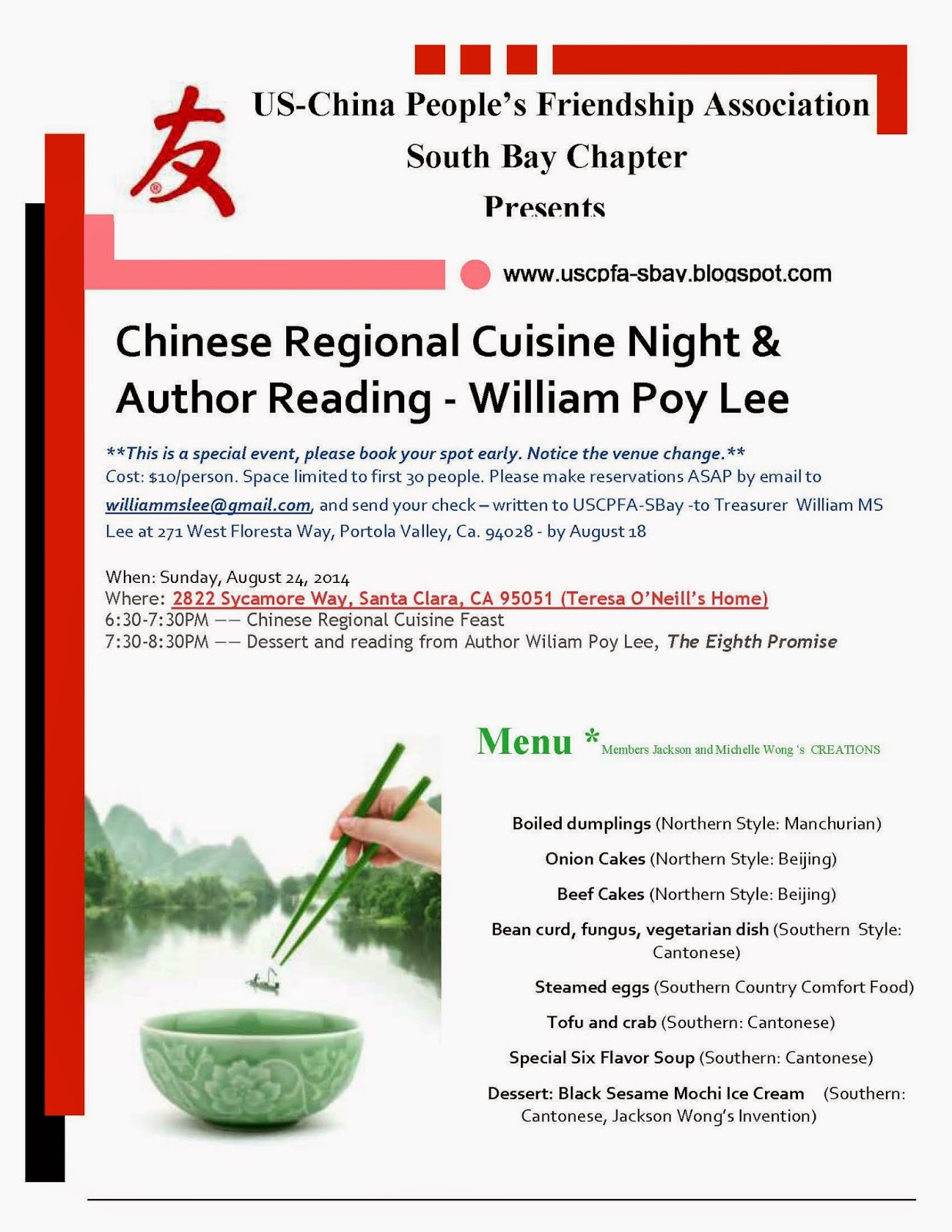
Monday, July 21, 2014

Monday, June 23, 2014

Tuesday, May 20, 2014
A Kung Fu Night


On May 4th 20 young performers from Fremont’s Legend
Kung Fu Academy demonstrated traditional Wushu, from the
Longfist to the Southern Broadsword to the Drunken Fist to the Eagle. The
performers, ranging in age from six to twenty jumped, twirled, flipped and split, making
us feel as though we were on the set of Crouching
Tiger Hidden Dragon.
Sunday, April 20, 2014

Thursday, April 17, 2014
Member John Marienthal Writes From Shanghai
John Marienthal writes
from Shanghai:
Hello from the second
biggest city in world--now 24 million people—where I am doing some volunteer
lecturing. The weather has just broken 70 degrees here.
I recently went to Zhejiang,
to visit a family I know in Wuyi county. It is something I’ve done almost every year
for the past ten years, and is a real joy. I have watched their children grow
up. I sit down with them at a meal and become "invisible" no fretting
or fawning over the wai guo ren (foreigner). I am treated as just part of
the family.
Wuyi Xian (county) is
located halfway between Hangzhou and Wenzhou (the shoe capital of China).
The town's claim to fame is a 700-year-old wooden bridge that crosses a river
in the middle of the town. The landscape is like Guilin only prettier
because they get rain year round. There are karst-like hills, volcanic
lava flows, mountains to 2000 to 3000 feet. In some ways many of the
things that you can see in Wuyi mirror positive things for China's
future.
When I first went to Wuyi
County in 2002 it had about 35000 people and six taxis. Now it has 50,000
people and they are even building a Walmart. They still have the KFC
there from ten years ago, but still no McDonald's or Starbucks. In 2002
it was a farming center. Now, like many other small Chinese cities, it is a
specialized industrial center. The town is the hub for the steel door, safety
door and security door capital of China. High growth has forced up housing prices. In
2002 prices were about 1000 rmb per square meter. Now they are reaching 12000
rmb per sq. meter.
I sat in on a ninth-grade
English class. As part of their lesson they read a passage about credit cards,
ATM's, and a cashless future via virtual money online. In 2002 all those
things would have seemed like science fiction. Yet today ALL three are now
available in Wuyi.
It used to take seven
hours on the slow train to reach this town. Now it takes 1 1/2 hours to get to
nearby Jinhua by fast train. The high speed train to Jinhua can travel at 175
miles per hour, but because of the 2011 accident on this same track it is
restricted to 130 mph.
There are high speed rail
connections to most of the highly-populated cities in eastern China . There is
even a new connection that runs between Hong Kong/Canton to Beijing. Here in Shanghai the trains are formidable
competition to airplane travel to Beijing. You can get on the fastest train and
go from the subway in Shanghai to downtown Beijing in five
hours. No long airport security lines, waiting for baggage, trying to find
transport at the other end.
I hope to do more
traveling while I am here.
Good health to you all,
Good health to you all,
John
Wednesday, April 16, 2014
Upcoming Brush Painting Demonstration
Shirley Lin Kinoshita will be demonstrating sumi-e (Japanese ink painting) Sat. April 26th ,10 am-4 pm at the Annual Cupertino Cherry Blossom Festival at Quinlan Community Center. The Festival is free and open to the public. Parking is available at Quinlan lot or DeAnza college.
Re-Cap of April Meeting with Artist Shirley Lin Kinoshita

According
to artist Shirley Lin Kinoshita, Chinese Ink Painting is not only the oldest
art form in the world, dating back 2-4,000 years, but is one of the highest art
forms in China. Despite this, she joked, no Asian parent wants his/her child to
be an artist. “Study to be a doctor. Or lawyer!”
Kinoshita
studied library science on full scholarship at UC Berkeley. For years she was a
full-time Medical Library Manager at Santa Clara Valley Health and Hospital. It
was only when she cut back on her hours as she neared retirement that she decided
to explore something different. A Chinese brush painting class was on offer, so
she gave that a try. She was immediately hooked, not only painting for profit
but also teaching others the form.
Ink
Painting consists of Four Treasures:
Ink
(pine soot mixed with glue molded into sticks),
Inkstone,
Brush
(made with animal hair and invented around 250B.C),
and
paper (invented by Chinese court official Ts’ai Lun around 105AD).
There
are also Six Canons of Chinese painting that every student learns, rules that
were created in 500AD by the painter Hsieh Ho.
1.
Chi’I
sheng-tung: Create spirit/life/vitality in art
2.
Ku-fa
Yung-Pi: Use the brush to create structure
3.
Ying-wu
hsiang-hsing: Draw its likeness
4.
Sui-lei
fu-ts’ai: Apply color in accordance with nature (i.e.no purple sunflowers)
5.
Ching-ying
wei-chi: Plan the design with each element in its proper place
6.
Ch’uan-I
mo-hseih: Study by copying the old masters
Of
these six rules, Kinoshita said, the first—qi/spirit-- is the most important. In
fact, “Asian brush painting is more spiritual than physical. It is believed
that the best painters are pure of spirit.” Underlying the philosophy of ink
painting is the unifying pattern of life in all its natural forms. She pointed
out, “Man is a humble, insignificant part in this scheme.”


Kinoshita
held up paintings she had done of bunnies representing life, and a rooster, hen
and chicks representing family, and three goldfish representing abundant wealth.
She explained that there were four plants most typically depicted, also known
as “the four gentlemen.”

She drew each one of the Four Gentlemen for us:
Bamboo
(representing strength and resilience.),
Chrysanthemum
(representing fidelity and friendship),
Plum
Blossoms (representing endurance)
and
the Orchid (representing humility.).
As
she said, “Chinese painting is much more than meets the eye. The composition
can easily be read, but unless its inner and symbolic meanings are recognized,
the whole painting will only be partially enjoyed.”
While
Kinoshita still paints, it is mostly for herself and to teach her
grandchildren. These days her days are filled as President of the Silicon
Valley United Nations Association. However, for those interested in pursuing their
artistic side, Kinoshita recommended two artists in the area. Ming Lee at the
Cupertino Senior Center and Judy Chu at the Sunnyvale Community Center.
(Photos courtesy of Billy Lee)
Subscribe to:
Posts (Atom)